
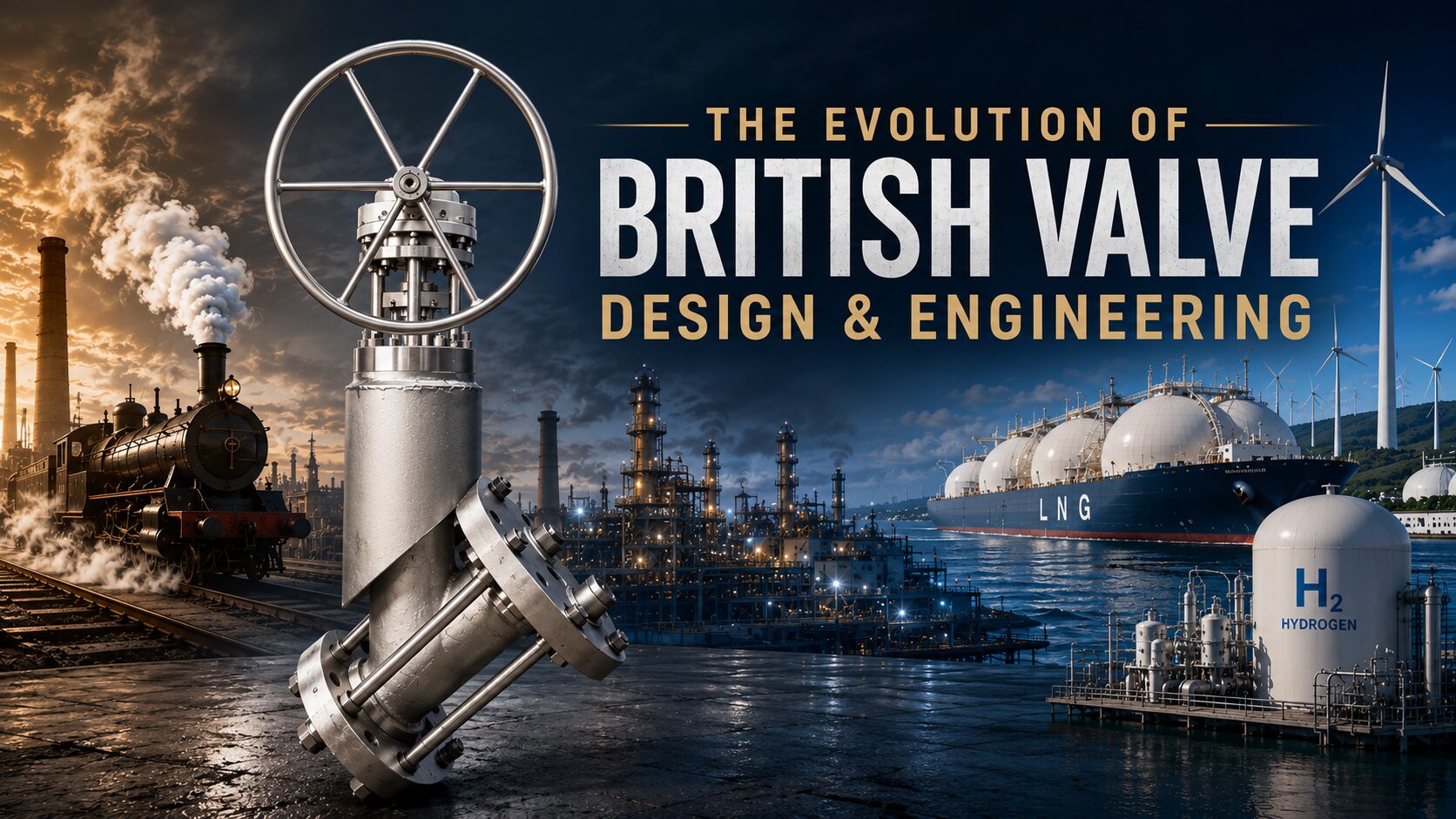
How Britain’s Flow Control Heritage Still Shapes the Modern Industrial World
British valve engineering is one of those quiet industrial success stories that rarely makes headlines, yet underpins almost every modern utility and process industry imaginable. From Victorian reservoirs and steam locomotives to LNG carriers, hydrogen systems and nuclear power stations, valves have always sat at the centre of industrial reliability. When they work properly, nobody notices. When they fail, entire systems can stop.
That reality is precisely why Britain developed such a formidable reputation for valve engineering in the first place.
The evolution of British valve design is not simply a story of manufacturing. It is a story of infrastructure, public safety, metallurgy, engineering discipline and long-term thinking. More importantly, it is a story that continues today through companies that still believe valves should be engineered as critical assets rather than disposable commodities.
For professionals across the UK water, power, steam, industrial gas and process sectors, the subject has perhaps never been more relevant. Britain now faces ageing infrastructure, stricter environmental regulation, decarbonisation pressures, resilience concerns and growing scrutiny around whole-life asset cost. In that environment, the old British engineering philosophy of durability and maintainability is beginning to look remarkably modern again.
At Blackhall Engineering, this philosophy survives through what the company calls “Valvology®” – a lifecycle-focused engineering approach centred around reliability, longevity, maintainability and technical accountability. As James Blackhall often argues, engineering should lead commercial decisions, not the other way around. The concept may sound modern, but in truth it reflects principles British engineers were applying more than a century ago.
Britain’s Industrial Revolution Created the Need for Reliable Flow Control
The origins of British valve engineering are inseparable from the Industrial Revolution itself.
By the mid-1800s, Britain had become the workshop of the world. Steam power was transforming manufacturing, rail transport, mining and shipping. Cities were rapidly expanding. Water infrastructure, gas distribution and industrial processing systems all required increasingly reliable methods of controlling pressure and flow.
The consequences of failure were severe.
Early steam boilers were notoriously dangerous, with explosions causing catastrophic loss of life throughout the nineteenth century. Water systems suffered from leakage, contamination and pressure failures. Industrial plants required better isolation and pressure control as operating conditions became increasingly demanding.
This pressure accelerated advancements in British machining, metallurgy and precision engineering.
Engineers such as Henry Maudslay helped pioneer precision machine tooling, enabling far tighter tolerances than had previously been possible. That seemingly simple advancement fundamentally changed valve performance because reliable sealing surfaces suddenly became repeatable at scale.
By the late Victorian era, Britain was exporting not only valves, but entire engineering philosophies around standardisation, safety and reliability.
Many of the principles introduced during that period still underpin valve engineering today:
- Pressure containment integrity
- Tight shut-off capability
- Repeatable machining tolerances
- Maintainability in confined spaces
- Long operational life
- Material suitability for harsh environments
These ideas eventually became formalised through British Standards and later international standards bodies.
The First Age of Valve Engineering: Reliability Above All Else
The earliest generations of British valve engineers were not focused on sustainability, digitalisation or lifecycle optimisation. Their challenge was much simpler: preventing failure.
Throughout the nineteenth century, Britain’s industrial expansion relied on steam power, water infrastructure, mining and manufacturing. In each of these sectors, valve reliability was critical. A leaking valve could waste valuable resources, while a failed isolation valve on a steam system could have catastrophic consequences.
This environment shaped a uniquely British engineering philosophy. Reliability was not a feature; it was a necessity. Manufacturers continually refined casting techniques, machining tolerances and material selection to create valves capable of operating for decades under demanding conditions.
Many of the principles established during this period remain fundamental today: robust pressure containment, dependable shut-off performance, maintainability and long service life.
Steam systems became one of the greatest proving grounds for these ideas. As power generation evolved, manufacturers such as Taylor, founded in 1904, developed specialist valve technologies capable of withstanding extreme temperatures and pressures. More than a century later, that engineering heritage continues through the TaylorShaw range within Blackhall Engineering, demonstrating how the pursuit of reliability remains at the heart of British valve design.
The Second Age: Engineering for Safety
As industries became larger and more complex throughout the twentieth century, reliability alone was no longer enough.
The rapid growth of chemical processing, petrochemicals, refining and power generation introduced new risks that demanded new engineering solutions. The focus began to shift towards safety, environmental protection and the containment of hazardous substances.
Valve manufacturers found themselves facing increasingly demanding duties involving toxic chemicals, aggressive media, extreme temperatures and higher operating pressures. The consequences of leakage were now measured not only in downtime, but also in environmental impact, regulatory compliance and human safety.
This period drove significant advancements in valve sealing technologies, materials science and emissions control. Bellows sealed valves, improved packing systems and more rigorous testing standards emerged as critical developments, helping operators achieve ever higher levels of safety and reliability.
Among the companies helping shape this movement was Shaw, founded in 1866, which became internationally recognised for its bellows sealed valve technology and commitment to zero-emission performance in hazardous applications. Today, that legacy continues through the Shaw range within Blackhall Engineering, reflecting a long-standing British engineering tradition of placing safety and environmental responsibility at the centre of valve design.
The Third Age: Engineering for Performance
Towards the end of the twentieth century and into the early twenty-first, valve engineering entered a new phase.
Global energy demand, international trade and increasingly specialised industrial processes pushed valve technology into environments that would have seemed unimaginable to earlier generations of engineers.
Cryogenic applications, LNG transportation, industrial gas production, offshore energy and advanced power generation all required valves capable of operating under extreme conditions. Temperatures below -150°C, severe thermal cycling and complex flow characteristics demanded entirely new approaches to design and validation.
The response was an increasing reliance on advanced engineering tools. Computational Fluid Dynamics (CFD), Finite Element Analysis (FEA), seismic modelling and sophisticated materials testing became integral parts of the design process, allowing engineers to predict performance with unprecedented accuracy before a valve ever entered service.
British manufacturers that embraced these technologies were able to compete successfully on a global stage. Blackhall is one example, developing specialist cryogenic valve solutions now accepted in more than 80 countries and used across LNG, industrial gas and emerging hydrogen applications. By combining traditional engineering discipline with modern analytical techniques, companies such as Blackhall demonstrated that heritage and innovation are not mutually exclusive.
Yet despite these technological advances, the objective remained remarkably familiar: creating valves that operators could trust when failure was simply not an option.
The Fourth Age: Engineering for Sustainability
Today, valve engineering is entering another significant transition.
The industry faces challenges that previous generations could scarcely have imagined. Net-zero commitments, carbon reduction targets, ageing infrastructure, water scarcity and energy transition programmes are forcing asset owners to rethink how infrastructure is specified, maintained and replaced.
Increasingly, the conversation is moving away from purchase price and towards whole-life value. Questions around longevity, maintainability, refurbishment potential, operational efficiency and embodied carbon are becoming central to engineering decision-making.
Asset owners are recognising that the most sustainable valve is often not the cheapest or even the newest, but the one that delivers reliable service for decades with minimal intervention. This shift is driving renewed interest in lifecycle engineering, refurbishment programmes and long-term asset management strategies that maximise value while reducing environmental impact.
In many respects, this represents a return to traditional British engineering values. Long asset life, repairability, robust construction and responsible stewardship are once again becoming strategic advantages. At Blackhall, these principles underpin the company’s Valvology® philosophy, the 100 Year Valve® concept and initiatives such as Renov8, which challenge the assumption that replacement is always the best solution.
The technologies may be different, but the philosophy feels remarkably familiar: build it properly, maintain it correctly and design it to serve future generations rather than short-term budgets. That principle has shaped British valve engineering for more than a century and remains just as relevant today.
The Return of Engineering-Led Manufacturing
One of the more interesting developments in UK industry is the renewed appreciation for engineering-led companies.
In a recent company discussion marking Blackhall’s sixty-year journey, Managing Director James Blackhall emphasised that the business remains fundamentally engineering-led rather than purely sales-led.
That distinction matters.
Across many industrial sectors, experienced engineers increasingly value suppliers capable of genuine technical consultation rather than catalogue distribution alone.
This is particularly relevant for complex applications involving:
- Reservoir drawdown systems
- Steam blowdown systems
- Hydrogen compatibility
- Cavitation control
- Emergency isolation
- Flow stability
- Legacy infrastructure upgrades
The reality is that modern infrastructure problems are rarely solved by products alone. They require engineering judgement.
That is arguably where the British valve industry still retains a competitive advantage.
From Steam to Hydrogen: The Continuity of British Engineering
Perhaps the most remarkable aspect of British valve engineering is how many original principles still apply within entirely new industries.
Hydrogen infrastructure, for example, presents fresh challenges around embrittlement, leakage prevention and safety management. Yet the underlying engineering philosophy remains familiar:
- Material integrity
- Reliable sealing
- Long-term durability
- Safe isolation
- Maintainability
- Risk reduction
Blackhall’s hydrogen valve range demonstrates how legacy engineering expertise can evolve into future energy systems.
Similarly, the company’s ongoing work in dams, reservoirs and hydropower shows how Victorian infrastructure principles continue to shape modern resilience planning.
The technologies may evolve, but the engineering mindset remains remarkably consistent.
The Future of British Valve Engineering
The future of British valve engineering will likely be defined by several converging pressures:
- Decarbonisation
- Infrastructure resilience
- Water scarcity
- Hydrogen expansion
- Nuclear investment
- Digital monitoring
- Asset lifecycle optimisation
Yet despite rapid technological change, the core engineering questions remain surprisingly unchanged from those faced by Victorian engineers:
- Will it last?
- Will it remain safe?
- Can it be maintained?
- What happens if it fails?
- What is the true cost over its lifetime?
Companies such as Blackhall Engineering, alongside the enduring Taylor and Shaw legacies, continue to position themselves around those questions rather than short-term procurement cycles.
That may ultimately explain why British valve engineering still commands global respect.
Because while technologies evolve, reliability never goes out of fashion.
And in critical infrastructure, reliability is still everything.