
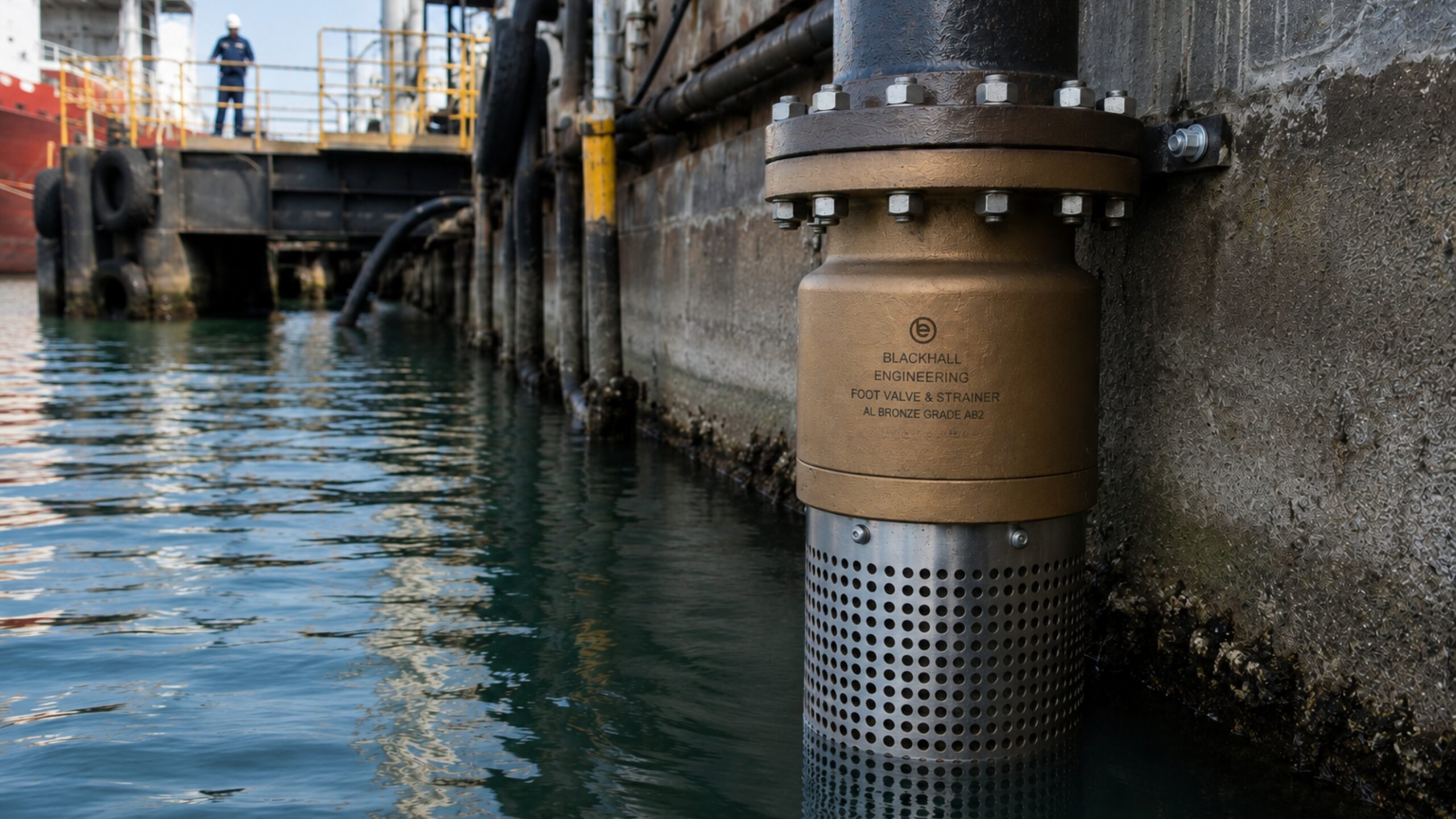
In dock pump systems, the biggest failures are often caused by the smallest assumptions. A pump may be correctly sized, the pipework may look robust, and the control philosophy may appear sound. Yet if the suction end of the system is poorly protected, the whole arrangement can become unreliable. That is where the foot valve earns its place.
A foot valve is not glamorous. It usually sits out of sight at the lowest point of a suction line, often submerged in dock water, seawater, river water or a raw water intake. It quietly performs two essential duties. First, it acts as a non-return foot valve, helping to keep the suction line full and the pump primed. Second, when paired with an effective strainer, it protects the pump from debris, marine growth and suspended solids that could damage impellers, block pipework or cause avoidable downtime.
For docks, harbours, dry docks, shipyards, offshore assets and marine pumping stations, that combination matters. A dock pump foot valve is not just an accessory. It is a frontline reliability component.
What is a foot valve and why does it matter?
A foot valve is a type of check valve installed at the inlet end of a pump suction pipe. In simple terms, it allows water to enter the suction line when the pump runs, but closes when the pump stops. This helps prevent the water column from draining back into the source. For many installations, especially where pumps sit above the water level, maintaining prime is critical. Without a suitable pump priming valve function, the pump may struggle to restart, run dry, lose efficiency or suffer mechanical damage.
This is why the term foot check valve is often used. It describes the same basic principle: one-way flow at the suction end. The valve opens under suction and closes when reverse flow begins. In a foot valve for pump applications, the design must balance free flow with secure closure. Too much restriction can increase suction losses. Too weak a closing action can allow drain-back. Too small a strainer area can starve the pump.
That last point is especially important in marine environments. A marine foot valve strainer has to do more than stop large debris. It must support stable pump operation by reducing the risk of blockage and maintaining the flow conditions required at the pump inlet. In practice, this makes the foot valve strainer a key part of pump cavitation prevention.
Why dock pump systems are so unforgiving
Dock pump systems work in difficult conditions. They may be used for dry dock filling and emptying, ballast support, seawater intake, cooling water transfer, washdown, emergency drainage, fire water support or general marine utility duties. The water source can contain weed, silt, shell fragments, rope fibres, packaging waste, sand, rust scale, biological matter and general dock debris.
A domestic foot valve for water pump use may only need to cope with relatively clean water. A water well foot valve or deep well foot valve may face sediment and long suction lifts. An irrigation foot valve may need to manage weed, algae and seasonal debris. A marine foot valve, by contrast, can face all of these challenges plus corrosion, tidal movement, salinity, impact risk and fluctuating operating patterns.
That is why material selection and design intelligence are so important. A brass foot valve may be suitable for some small clean water or light-duty systems. A stainless steel foot valve can offer good general corrosion resistance in certain environments. However, marine and seawater intake duties often demand more specialised thinking, particularly when chloride exposure, galvanic interaction, flow velocity and long-term maintainability are considered.
In demanding seawater service, an aluminium bronze foot valve is often a serious engineering choice. Aluminium bronze has a long-standing reputation in marine applications because of its strength and resistance to seawater corrosion. When combined with the right design, strainer geometry, seating arrangement and quality control, it can help protect the pump system over a long operating life.
The strainer is not an afterthought
It is tempting to think of the valve as the important part and the strainer as a simple cage. In reality, the marine raw water strainer is integral to system performance. It influences flow area, suction losses, debris capture, maintenance frequency and pump protection.
A poorly specified foot valve strainer can create hidden problems. If perforations are too small, the strainer may block too quickly. If they are too large, damaging debris can pass through. If the open area is insufficient, the pump may be starved, increasing the risk of cavitation. If the strainer is difficult to access, operators may delay inspection until performance has already deteriorated.
The best approach is to start with the duty, not the catalogue. What is the pump flow rate? What is the available net positive suction head? What type of debris is expected? Is the application intermittent or continuous? Is the valve submerged in seawater, brackish water or fresh water? Does the installation experience tidal movement? Is there a need for a floating foot valve arrangement to draw from a preferred water level and avoid bed silt?
These are practical questions, but they are also Valvology questions. At Blackhall, Valvology is about understanding the complete behaviour of the flow control asset in its real operating environment. It is not just about supplying a valve that fits the pipe. It is about making sure the valve, pump, pipework, materials, maintenance regime and operating philosophy work together.
Foot valve for water pump, dock pump or seawater intake: the differences matter
Many search terms sound similar: foot valve for pump, foot valve for water pump, pump suction foot valve, dock pump foot valve and seawater intake valve. In practice, the correct specification can vary significantly.
For a clean water transfer pump, the priority may be reliable priming and simple maintenance. For a water well foot valve, the design may need to suit long vertical suction lines, sediment exposure and dependable reseating after repeated cycles. For an irrigation foot valve, seasonal debris, plant matter and ease of cleaning may be central.
For a marine foot valve, the duty is usually more severe. Seawater is corrosive. Dock water can be dirty. Access can be difficult. Downtime can disrupt vessel movements, maintenance schedules and port operations. In these conditions, low-cost replacement thinking can become expensive very quickly. A valve that appears economical at purchase can cause repeated lifting, diver attendance, pump intervention, unplanned shutdown and consequential delay.
This is where Blackhall’s dependability, integrity and intelligence become commercially relevant. Dependability is the confidence that the valve will perform when required. Integrity is the assurance that the recommendation is based on the duty, not merely the easiest sale. Intelligence is the engineering judgement behind material choice, strainer design, pressure rating, testing and through-life support.
How foot valves help prevent pump cavitation
Pump cavitation is one of the most damaging symptoms of poor suction conditions. It occurs when local pressure falls low enough for vapour bubbles to form and then collapse violently as pressure recovers. The result can be noise, vibration, impeller erosion, seal damage, reduced flow and shortened pump life.
A foot valve contributes to pump cavitation prevention in several ways. It helps maintain prime, reducing the likelihood of air entering the suction line before start-up. It supports a flooded or stable suction condition where the system has been correctly designed. The strainer prevents larger debris from entering the pump and disturbing internal flow. A properly sized strainer also limits suction restriction, helping protect the net positive suction head available to the pump.
However, a foot valve cannot compensate for poor system design. If the suction line is undersized, the lift is too high, the strainer is too restrictive, the pump is badly selected or the inlet is positioned in a turbulent zone, cavitation risk remains. That is why foot valve selection should be part of a wider suction-side review. In a dock setting, the most valuable question is rarely “what size valve fits this pipe?” It is “what does this pump need at its inlet to operate reliably over the next decade?”
Blackhall Series 4800 Foot Valves and Strainers for marine applications
Blackhall’s marine valve range includes Series 4800 Foot Valves and Strainers, developed for harsh marine environments where corrosion resistance, robust construction and reliable operation are non-negotiable. The wider marine range includes gate valves, check valves, butterfly valves, globe stop and control valves, and foot valves and strainers, supporting a complete approach to marine flow control.
For readers looking specifically at dock, harbour and seawater duties, Blackhall’s dedicated marine foot valves and strainers is the natural next step. For wider project specification, including gate, globe and check valve requirements across vessels, FPSOs, offshore rigs and naval applications, explore Blackhall’s corrosion-resistant marine valve solutions.
Blackhall’s marine valves are engineered from aluminium bronze and other specialist materials, with options such as titanium, duplex, super duplex, Monel, Hastelloy, Inconel and Alloy 20 considered where the duty requires them. The Series 4800 foot valve and strainer range sits within this broader marine capability, supported by more than 50 years of marine valve manufacturing experience and a global reputation built across demanding applications.
That heritage matters because marine pump systems are rarely standard in the real world. Pipework may be constrained by existing civil structures. The water source may be aggressive. The installation may be old, modified or poorly documented. Access may involve confined spaces, lifting restrictions, divers or shutdown windows. A dependable valve partner understands these practical realities before recommending a solution.
British manufacturing and the value of doing it properly
Ports and marine operators are under increasing pressure to improve resilience, reduce emissions and manage assets more intelligently. The International Maritime Organization’s 2023 greenhouse gas strategy set a sector ambition for international shipping to reach net-zero greenhouse gas emissions by or around 2050, with interim ambitions for lower carbon intensity and greater uptake of zero or near-zero emission technologies. In the UK, the Maritime Decarbonisation Strategy sets goals for domestic maritime to reduce fuel lifecycle greenhouse gas emissions by at least 30% by 2030 and 80% by 2040, relative to 2008 levels.
At first glance, a foot valve may seem far removed from decarbonisation. It is not. Reliable valves help pumps run efficiently, reduce avoidable callouts, extend asset life and minimise premature replacement. Poor suction performance wastes energy. Repeated failures increase transport, lifting, labour, replacement and disruption. Intelligent specification is therefore part of a lower-waste asset strategy.
This aligns naturally with Blackhall’s British manufacturing ethos. Manufacturing in West Yorkshire is not just a matter of geography. It is a way of protecting knowledge, quality, responsiveness and accountability. When a customer needs advice on a marine foot valve, a dock pump suction arrangement or a seawater intake valve, they are not simply buying a component. They are accessing people who understand valves as long-life engineering assets.
The people element is easy to overlook, but it is central to Blackhall. Design engineers, machinists, service teams, sales specialists and Valvologists all contribute to the final result. Innovation is not only found in software or digital monitoring. It is found in the conversations that prevent a poor selection, the material decision that avoids premature corrosion, the inspection regime that catches a problem early, and the manufacturing discipline that ensures a valve performs as intended.
Material selection: brass, stainless steel or aluminium bronze?
Search behaviour often groups foot valves by material: brass foot valve, stainless steel foot valve and aluminium bronze foot valve. Each has its place, but the correct choice depends on the medium and the consequence of failure.
Brass is common in small water systems and can be cost-effective for light-duty applications. Stainless steel is often selected for corrosion resistance, hygiene or general industrial durability, although grades and chloride conditions must be carefully assessed. Aluminium bronze is widely valued in marine service because it combines mechanical strength with seawater corrosion resistance.
In dock pump systems, the cheapest material can become the most expensive choice if it leads to seizure, leakage, strainer collapse, dezincification, galvanic corrosion or repeated maintenance. Blackhall’s approach is to consider the duty as a whole. This includes water chemistry, pressure, temperature, suction conditions, debris profile, neighbouring materials, expected service life and access constraints.
A practical Valvology checklist for foot valve selection
Before specifying a pump suction foot valve, ask these questions:
What is the fluid: freshwater, brackish water, seawater or contaminated dock water?
What debris is expected: weed, silt, shells, rope fibres, plastic, stones or marine growth?
What is the pump duty: continuous, intermittent, emergency standby or seasonal?
What suction conditions are available, including lift, pipe length, velocity and net positive suction head?
What material is compatible with the water chemistry and adjacent pipework?
How will the strainer be inspected, cleaned and maintained?
Is a fixed inlet suitable, or would a floating foot valve help avoid bed silt?
What are the consequences of failure in operational, safety and environmental terms?
This kind of structured questioning reflects Blackhall’s consultancy-led approach. It helps move the conversation from “supply a foot valve” to “protect the pump system”.
The unsung hero that protects the headline asset
Pumps usually receive the attention. They have motor ratings, performance curves, controls and energy figures. The foot valve sits quietly beneath the surface. Yet when it fails, everyone notices.
A reliable foot valve for pump protection keeps the suction line ready, protects against reverse flow, reduces debris ingress and supports stable operation. In marine and dock systems, the right marine foot valve strainer also protects against the unique realities of seawater, silt, biological matter and difficult access.
For Blackhall, this is exactly the kind of component that deserves serious engineering thought. It may be small compared with the dock, vessel or pumping station it serves, but its role is critical. Specify it well, manufacture it properly and maintain it intelligently, and the foot valve becomes what every good valve should be: dependable, quietly effective and ready when needed.
FAQs
What does a foot valve do in a dock pump system?
A foot valve sits at the suction inlet and allows water to enter the pump suction line while preventing reverse flow when the pump stops. In dock pump systems, it helps maintain prime, supports reliable start-up and protects the pump when combined with a correctly designed strainer.
Is a foot valve the same as a check valve?
A foot valve is a type of check valve, which is why it is sometimes called a foot check valve or non-return foot valve. The difference is its location and function. It is installed at the bottom of the suction line, often submerged, and usually includes or works with a strainer.
Why is a strainer important on a marine foot valve?
A marine foot valve strainer prevents larger debris from entering the suction line and damaging the pump. It also helps maintain stable suction conditions, provided it is correctly sized and cleaned at suitable intervals. In seawater and dock environments, the strainer is essential for pump reliability.
Which material is best for a seawater foot valve?
For demanding seawater duties, aluminium bronze is often preferred because of its strength and corrosion resistance in marine environments. Stainless steel and brass foot valves may suit other applications, but seawater service should always be assessed carefully against chloride exposure, galvanic compatibility and access for maintenance.
Can a foot valve help prevent pump cavitation?
Yes, but only as part of a correctly designed suction system. A foot valve helps maintain prime and a strainer helps prevent debris-related flow disturbance. However, pump cavitation prevention also depends on suction pipe sizing, available net positive suction head, inlet positioning, flow velocity and pump selection.
When should a floating foot valve be considered?
A floating foot valve may be useful where the water source contains bed silt or settled debris. By drawing water from a preferred level rather than the bottom, it can reduce sediment intake. The suitability depends on the site, water level variation, hose arrangement and operating duty.
How often should a marine raw water strainer be inspected?
Inspection frequency depends on debris levels, water quality and operating hours. High-debris dock environments may require frequent checks, especially during seasonal weed growth or after storms. Blackhall’s Valvology approach would consider the duty, consequence of blockage and maintenance access before recommending an inspection regime.
Why involve Blackhall early in foot valve specification?
Early involvement helps avoid common problems such as poor material selection, undersized strainers, excessive suction losses and difficult maintenance access. Blackhall’s Valvologists look at the valve, pump and system together, helping customers specify a solution that supports long-term reliability rather than short-term convenience.