
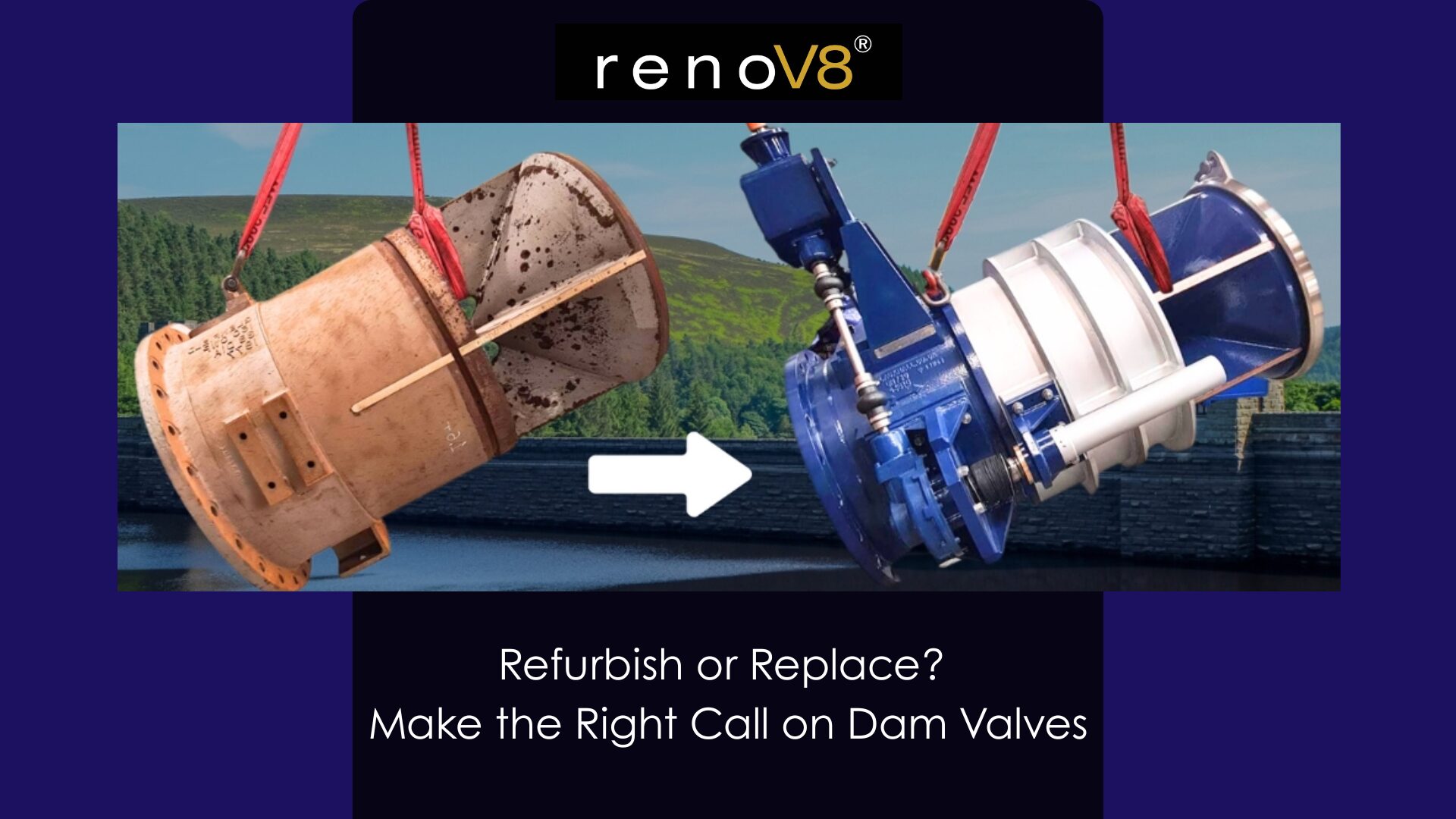
Dam and reservoir operators are under growing pressure to do three things at once: maintain safety, control whole life cost and reduce carbon. That is not easy when ageing water infrastructure valves are buried in cramped chambers, exposed to silt, corrosion, difficult operating conditions and long maintenance intervals. Yet the decision is rarely as simple as old equals replace.
In practice, many valves declared beyond economical repair are not truly at the end of life. They may be suffering from seized operating gear, worn seating surfaces, stem damage, leakage, coating breakdown or performance drift that can be corrected through a disciplined valve overhaul service. Just as importantly, some valves should not be refurbished because the underlying design is wrong for the duty, the castings are unsound, or the residual risk remains too high.
The timing matters. Ofwat’s PR24 final determinations have set out £104 billion of sector spending for 2025 to 2030, while the UK water sector continues to work towards its net zero operational carbon ambition and reservoir safety reform in England and Wales is actively progressing. In other words, asset owners are being pushed towards more resilient, evidence-based and lower carbon infrastructure choices. That makes the refurbish or replace question more commercially and strategically important than it was even a few years ago.
That is where a structured decision process matters. Blackhall’s valvology® approach and the RENOV8® philosophy bring engineering judgement back into the centre of the conversation. Rather than jumping straight to procurement, the starting point is a proper valve condition assessment, failure mode review and lifecycle decision. The outcome may be a reservoir valve refurbishment, a targeted upgrade, or a full replacement with a better configured duty arrangement. The intelligent decision is the one that protects people, the environment and the asset owner’s budget.
For operators managing gate valves, Larner-Johnson® valves, fixed cone valves and other large bore water assets, the best question is not “How old is the valve?” It is “What condition is it in, what duty must it perform, and what is the most dependable path to another safe service interval?”
Signs Your Reservoir Valve Needs Refurbishment
The first sign is usually operational change. A valve that once moved smoothly begins to run tight, requires higher torque, or becomes intermittently unresponsive. That kind of valve performance degradation often points to bearing wear, debris build-up, spindle issues, corrosion products, coating loss or internal damage. In reservoir environments, silt and lack of regular cycling can accelerate the decline.
Leakage is another major indicator. Passing seats, external seepage, gland leakage and loss of shut off integrity are all warning signs that a valve end-of-life assessment is needed. But leakage alone does not automatically mean replacement. In many cases, industrial valve repair and refurbishment can restore sealing performance through re-machining, re-lapping, replacement of worn internals, improved coatings and better materials at known wear points.
Seized valve repair is also a common trigger. A seized valve in a dam or reservoir is more than a maintenance nuisance. It can affect drawdown capability, emergency planning and regulatory confidence. The worst response is often a rushed attempt to force the valve free without understanding the cause. Safe diagnosis matters. Excessive torque on a distressed asset can convert a recoverable valve into a failed one.
There are also more subtle signs of valve failure in reservoirs. Slow closing or opening times, unusual noise or vibration, backlash in operating gear, persistent need for manual intervention, and recurring maintenance findings all suggest that the asset is moving from routine care into a repair or refurbishment decision zone.
For gate valve refurbishment in particular, attention should be paid to seat wear, guide condition, stem integrity, packing, bonnet sealing, bypass function, and evidence of debris or mineral accumulation. On older parallel slide and parallel faced arrangements, the question is not simply whether the valve still moves, but whether it still isolates safely and predictably under the real operating head.
A useful rule is this: when the valve body and core structure remain fundamentally sound, refurbishment is often worth serious consideration. When the failure is localised, accessible and technically remediable, water infrastructure valve refurbishment can be the most sustainable and commercially intelligent option.
Step by Step Valve Condition Assessment Framework
The strongest refurbish vs replace valves decisions follow a sequence, not a guess.
Step one is the valve asset audit. Establish what is actually installed, where it sits in the system, what duty it performs, its age, maintenance history, prior failures, operational criticality and any known modifications. Too many replacement decisions start with incomplete records.
Step two is a functional review. Ask whether the valve is being used for the duty it was designed for. In older reservoir systems it is not unusual to find isolation valves being used for throttling or flow control. That mismatch accelerates wear and can make replacement, reconfiguration or duty separation more sensible than refurbishment alone.
Step three is inspection and testing. This should combine visual assessment, operational testing, leakage review, torque or thrust observations where possible, and internal examination. For buried or confined assets, endoscopic inspection can be especially valuable. Valve inspection and testing should aim to identify not only symptoms, but the actual failure mode.
Step four is material and structural assessment. This is where non-destructive testing valves work becomes important. Depending on the asset, ultrasonic inspection, radiography, thickness checks, metallurgical review and coating assessment may be appropriate. The key question is whether the main castings and pressure retaining parts are reusable. If the body is structurally sound, refurbishment remains on the table. If there is deep section loss, major cracking, graphitisation or unsafe degradation, replacement moves ahead.
Step five is risk and consequence review. How critical is this valve to drawdown, isolation, compensation flow, environmental protection or public safety? What happens if it fails in operation? What are the consequences of keeping it in service after repair versus replacing it? This is where asset management water infrastructure decisions need engineering judgement, not just spreadsheet logic.
Step six is options development. A proper proposal should compare like for like refurbishment, refurbishment plus upgrade, partial remanufacture, actuator upgrade, operating gear refurbishment, and full replacement. This is also the point to consider whether on site works or factory overhaul is the better route. Blackhall’s on site capability is particularly relevant where access, lifting, outage windows or confined spaces shape the method of intervention. See Blackhall’s on site valve services here: Blackhall’s on site valve services.
Step seven is verification. If refurbishment proceeds, it should be backed by defined overhaul scope, quality control, testing, certification and recommissioning. If replacement proceeds, the specification must solve the original problem rather than merely supplying a newer version of the same weakness.
This is the difference between a reactive repair and valve lifecycle management.
Refurbishment vs Replacement: Cost and Carbon Comparison
The cost of valve refurbishment vs replacement is rarely just the invoice value of the valve. For dams and reservoirs, the real calculation includes access works, lifting strategy, civil modifications, outage implications, programme risk, transport, installation complexity, commissioning, and future maintenance burden.
Refurbishment often delivers a strong return where the valve body is sound and the defect is concentrated in the internals, seating system, spindle, coatings or actuation components. Large bore valve refurbishment can be particularly attractive because the cost and disruption of replacing major assets rises quickly once civils, removals and bespoke manufacture are involved.
There is also a carbon argument that is becoming harder to ignore. Sustainable valve solutions are no longer a marketing extra. They are part of modern asset management. Refurbishment keeps substantial embodied material in service, reduces the need for entirely new manufacture and can avoid transport emissions associated with full replacement supply chains. Under RENOV8®, Blackhall has highlighted a like for like comparison showing valve refurbishment delivering an eightfold reduction in carbon output versus importing a replacement equivalent. That makes refurbishment vs replacement carbon footprint a meaningful board level issue, not just an engineering footnote.
The commercial logic is similar. Refurbishment can extend asset life significantly, improve reliability and defer capital spend without compromising safety, provided the condition assessment is robust. In some cases, targeted upgrades during refurbishment such as improved spindle materials, better coatings, stainless bolting, revised bearings or modernised operating gear can leave the asset performing better than it did originally.
That said, replacement is the right answer when the valve is fundamentally the wrong design, no longer provides the required duty, cannot be made structurally sound, or would still present unacceptable residual risk after overhaul. The best way to extend lifespan of water control valves is not to refurbish everything. It is to refurbish the right valves and replace the wrong ones at the right time.


How RENOV8® Supports Sustainable Valve Lifecycle Management
RENOV8® gives asset owners a practical route to sustainable alternatives to replacing industrial valves. Its logic is simple but powerful: assess first, intervene intelligently, preserve valuable assets where safe to do so, and use refurbishment as part of a wider lifecycle strategy.
That approach fits naturally with Blackhall’s British manufacturing heritage, engineering innovation and people-first service culture. It also reflects the company’s defining traits. Dependability means recommendations are grounded in safety and long term performance, not short term sales. Integrity means being honest when a valve should be replaced. Intelligence means understanding failure modes, duty conditions and the hidden cost of poor specification.
In practical terms, RENOV8® works best when it is linked to a broader asset management programme. Blackhall’s VAMP® service helps customers build that visibility by combining inspections, condition reporting, maintenance history, digital tagging and forward planning. For operators asking how to assess end-of-life valves in reservoirs, or how to extend valve lifespan without increasing risk, that visibility is crucial. Explore VAMP® here: VAMP®.
For refurbishment delivery itself, Blackhall’s valve repair and refurbishment service provides the route from assessment to action, whether the need is gate valve refurbishment, parallel slide gate valve repair, seized valve repair, operating gear overhaul or a full factory strip, inspection and test programme. Learn more here: Blackhall’s valve repair and refurbishment service.
The bigger point is this. Dam valve refurbishment should not be treated as a compromise option between doing nothing and buying new. When supported by proper inspection, non-destructive testing, engineering redesign where needed, and disciplined testing, it becomes a strategic tool for ROI of valve refurbishment programmes, circular economy in water industry thinking and long term resilience.
In a sector managing ageing water infrastructure valves under tighter scrutiny, the smartest asset owners will be the ones who stop asking for quick answers and start asking better questions.
FAQs for Dam and Reservoir Valve Decision-Making
1.When should you refurbish a dam valve instead of replacing it?
Refurbish when the main body and pressure retaining structure are sound, the failure mode is understood, and the required duty can still be met after overhaul or upgrade. Replace when the structure is compromised, the design is unsuitable, or the residual risk remains too high.
2. What are the most common signs of valve failure in reservoirs?
Tight or seized operation, leakage, rising operating torque, poor shut off, erratic movement, vibration, corrosion, coating breakdown and recurring maintenance issues are among the clearest warning signs.
3. Can large bore and heritage valves really be refurbished safely?
Yes, provided the valve condition assessment is rigorous. Many older assets can be restored through strip inspection, reverse engineering, material upgrades, re-machining and full testing. The key is proving structural fitness, not assuming it.
4. How do you decide between dam valve repair services on site and factory overhaul?
That depends on access, outage windows, lifting constraints, fault severity, testing requirements and whether the work affects major internals or pressure retaining parts. A valvology®-led review should decide the method, not convenience alone.
5. What is the ROI of valve refurbishment programmes?
The return often comes from deferred capital replacement, reduced civils, lower outage costs, retained embodied carbon, improved reliability and longer service intervals. The better the inspection data, the stronger the ROI case becomes.
6. How does valve lifecycle management reduce risk?
It replaces reactive maintenance with planned inspection, condition trending, targeted intervention and smarter budgeting. That improves reliability, supports reservoir safety obligations and reduces the chance of emergency failure.
If you are reviewing ageing dam or reservoir valves, the best first move is not procurement. It is a structured condition assessment that tells you whether refurbishment, upgrade or replacement is the right engineering answer.